Today’s prompt from the Ultimate Blogging Challenge is to talk about what or who inspires you.
One of the things that I do as a community journalist is to interview some very interesting people, who share their stories with me. Their stories are incredible, and I am so grateful that they trust me to share their stories with my readers. When I talk to them and when I share their stories, I have the opportunity to talk about people at their best. That is so inspiring for me. I would like to introduce one of them to you. I interviewed Bud Long in 2022 for the Island Dispatch. Bud was a World War II veteran, who grew up on Grand Island, New York. One of the kids he went to school with in the 1920s and 1930s was a boy named Charlie DeGlopper. Charlie, who was a glider pilot with the 82nd Airborne Division, was killed during fierce fighting on June 9, 1944, several days after D Day. He was trying to save his regiment and to create a distriction by standing and firing at the Germans. He was a very tall man and was a large target. Because of his actions, the Germans were not able to gain access to the La Fière Bridge over the Merderet River at La Fière, France. Charlie, who died at age 22, was pothumously awarded the Medal of Honor in 1947.
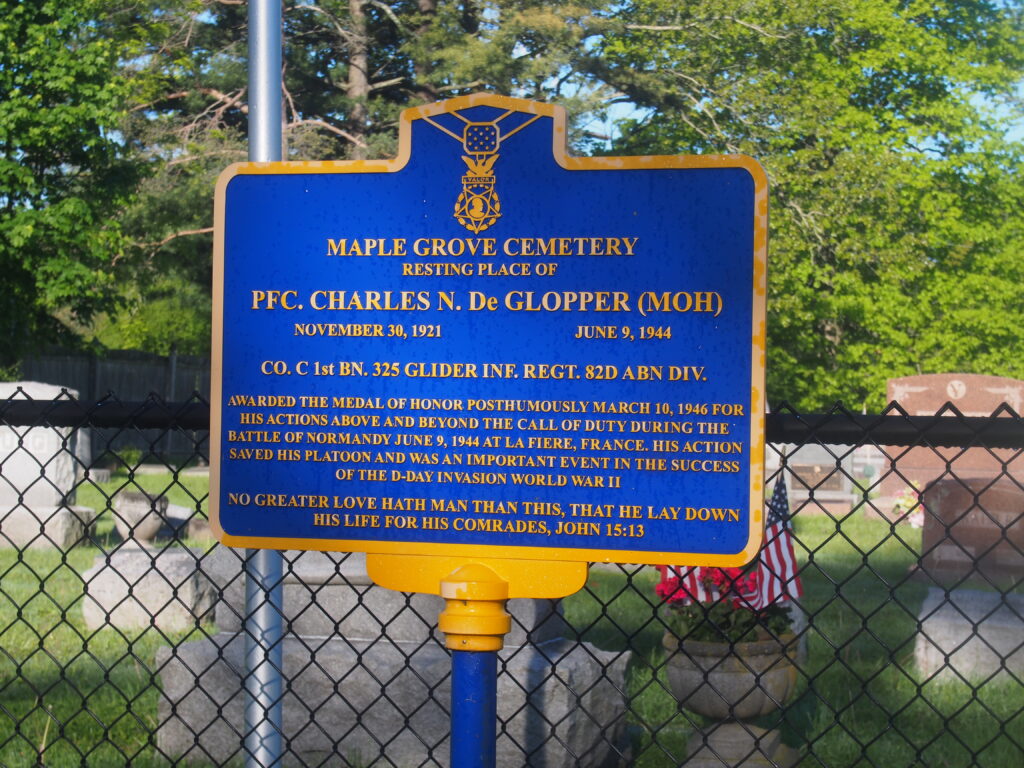
“He went into the service with me. He was 6’6”. They didn’t have an outfit to fit him. He had a size 13 or 14 shoe. They didn’t have shoes to fit him. We were at Fort Niagara recruiting place to get your clothes and to get the heck out to go someplace else. After three days, I had my whole uniform. We sent my civilian clothes home. On the third day, they shipped me out to St. Petersburg, Florida. He was still there with his civilian clothes on,” Bud said.
Charlie and Bud attended one room schoolhouses together and they became friends who joined a gentlemen’s club, where they enjoyed learning how to cook. During World War II, they were drafted together. Charlie became a glider pilot, and Bud, who had mechanic skills, became an airplane mechanic.
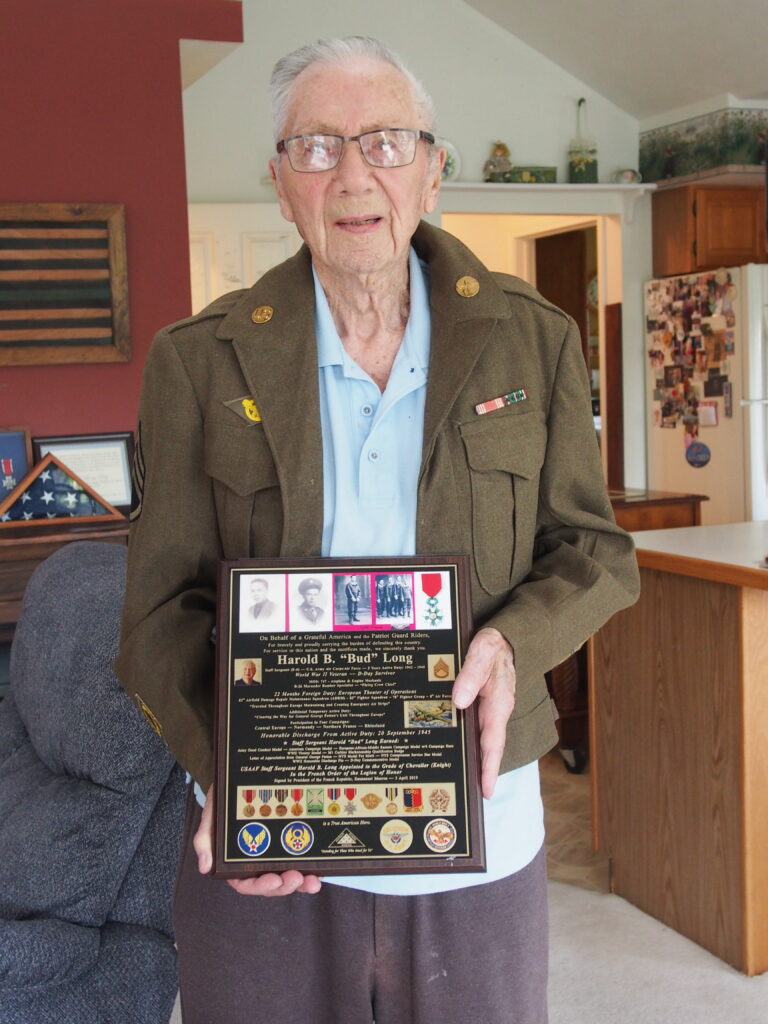
When Bud told his World War II story, I felt as if I were there with him. His narration was incredible. He motivated me to tell better and, I hope, more compelling stories. Here is one part of Bud’s story:
“There were only 12 men in my outfit, all of us mechanics. Our main outfit came in about four or five days later. There’s no record of it. I don’t know what happened to the combat outfit or anything else. My outfit caught up to me, and we stayed together for the whole war. We operated a main strip between the infantry and the artillery for emergency planes to land on our side of the line. We maintained 48 different places. I saw Europe. On the beach, we captured a German truck, painted OD (olive drab) colors on it, put a fake number on it and drove it all through Europe. We drove through Holland, Luxembourg, and Germany. In Linz, Austria, we met the Russians. We had a great time. I was in four major battles. I got a citation from Patton. He saw me twice. He came to our outfit. He couldn’t get gas anymore. Their tanks use the same as our planes: 100 octane. He came in and tried to get our gas. Our main man was a major. Patton was a general. You ought to have seen those two going at it. Our major was a World War I vet and he didn’t back down to nobody. I think that’s why he never made it above major because he was a mouthy sun of a gun. He’d sound off. He’d pull out a citation from Eisenhower, which said to give Patton no more gas because we can’t keep up with the supplies. We’ll give him all the ammo he wants but he’s gonna sit here. He couldn’t get the supplies to the front fast enough They went round and round and finally Patton got into a Jeep and drove off.
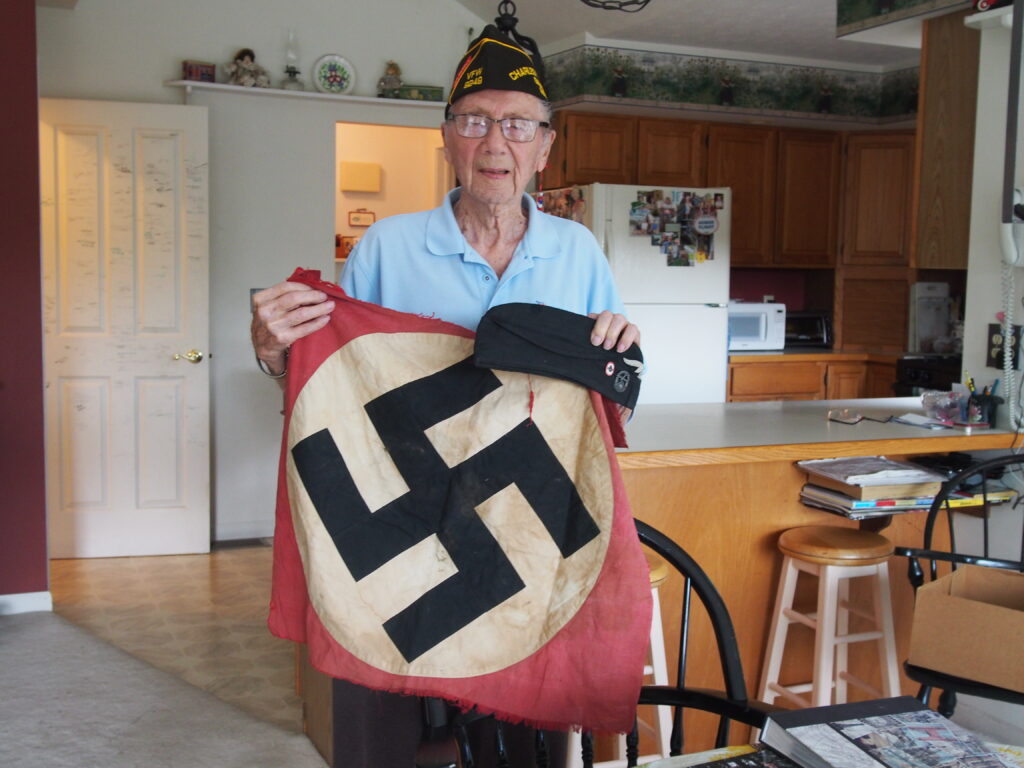
Here is another story that the incomparable Bud shared with me:
“We had a lieutenant with us. Saunders. He was like one of us. . He say give me that uniform, I’m going to go with you. He’d put on any GI uniform and go into town with us. He said don’t call me sir anymore. He liked to party and all that. There was a town maybe twice the size of Nunda (a small town in Western New York). He said, there’s a school and the kids can’t go because they don’t have any coal to heat it. So we went in and talked to the ones in charge. He said, tell you what. We’ll get you some coal for the school. We’ll get the fire going. It was like Sidway (a school in Grand Island, New York) was. It had six or eight rooms in it. The auditorium was a combo. There was a basketball court. And there was a small kitchen. That was a coal mining area and just about two miles back was a big coal mine. We went and got some coal and got the fire going. We’ll get three of the rooms for the kids and they can use the auditorium and the kitchen. We’ll bring a box of rations. The kids had nothing to eat. We fed them in the morning and gave them a lunch. They only stayed until a little after lunch and then they went home. We sent a box home for them to bring to their families. We got there a week before Thanksgiving and stayed there until the second week of February. We got to know the people. We got to know the town. There was a theater there. It had water up to the second or third level. The basement was full. We pumped the water out. We got the furnace going with some coal in there. There was a USO show at Christmas time there. There was a hotel. It had a bar and a restaurant downstairs.
“(The owner of the hotel) was there all the while the Germans were there. ‘You guys are nothing like them. You treat us like human beings.. They ate and drank and raised heck and kicked the place apart and paid for nothing. She had chickens. She’d mixed stuff with it. She had a small garden with onions and peppers and stuff like that. It made for a fairly good meal. She had ten bedrooms upstairs. We slept upstairs that winter. We had a feather bed and covered up with a feather blanket. She was a great gal. When we were leaving, she was crying as if we were leaving home. She had two daughters. One was 22 and the other was 18 or 19. They’re crying because they will never see us again. We said that we would stop and see them. And we did.”
Unfortunately, Bud passed away a few months after our interview. During our two-hour interview, I became very fond of him. He was brave and kind. He had an incredible sense of humor. He was a true inspiration for me.


Love this!
This is the type of history we need to record more often so people don’t forget what these brave men and women did for us.
Yes, we absolutely need to share these stories. These folks were incredible and so brave.
There isn’t many of those men left. Their voices matter. Thank you for taking the time to write down his memories.
Thank you. He was a true gift to me. What a wonderful man, and it was my honor to spend time with him and listen to his stories. He witness history and I had the opportunity to share his story. I was very much the lucky one.
Wonderful to hear of your interview with Bud and his memories of the brave men he served with too. I can see how he inspired you, definitely a fabulous encounter. Your work Alice as a journalist in the community sounds like it must be very satisfying and so interesting. Hello again and best wishes to you Alice, from Alice 🙂
Hi Alice, thank you so much. My work is really interesting and I learn something new all of the time.
Also, it’s nice to talk to you again!
Alice, thank you for these amazing stories. You close by saying unfortunately Bud passed 2 months after you interviewed him. I experience the love and direction of the Divine: what if Bud needed to pass, but Heaven made sure he was alive long enough to share his story with you? So you have in your heart and in your computer a God-given gift of life stories. I hope these are online and the public is encouraged to see these profiles.
Btw my father was 6’6″, and had his eyesight been better and had they taken him, he would also have needed special help with uniforming. My dad instead worked in a secret facility, developing something that helped end WWII.
Oh Kebba, I love the way you reframed Budd’s passing. It was actually a family member of Bud’s who made sure that I interviewed him. He lived in a different town, and she drove me all of the way there and visited with other family members while I was interviewing Bud. I honestly did not expect that interview to last for two hours, but Bud was really special. I am so grateful to Nancy for making sure that I was able to interview Bud.
Your father sounds like he was a very interesting man. My dad was in the military and he served in signal intelligence. He was a math genius, I think. Needless to say, that was a trait that I did not inherit, lol.