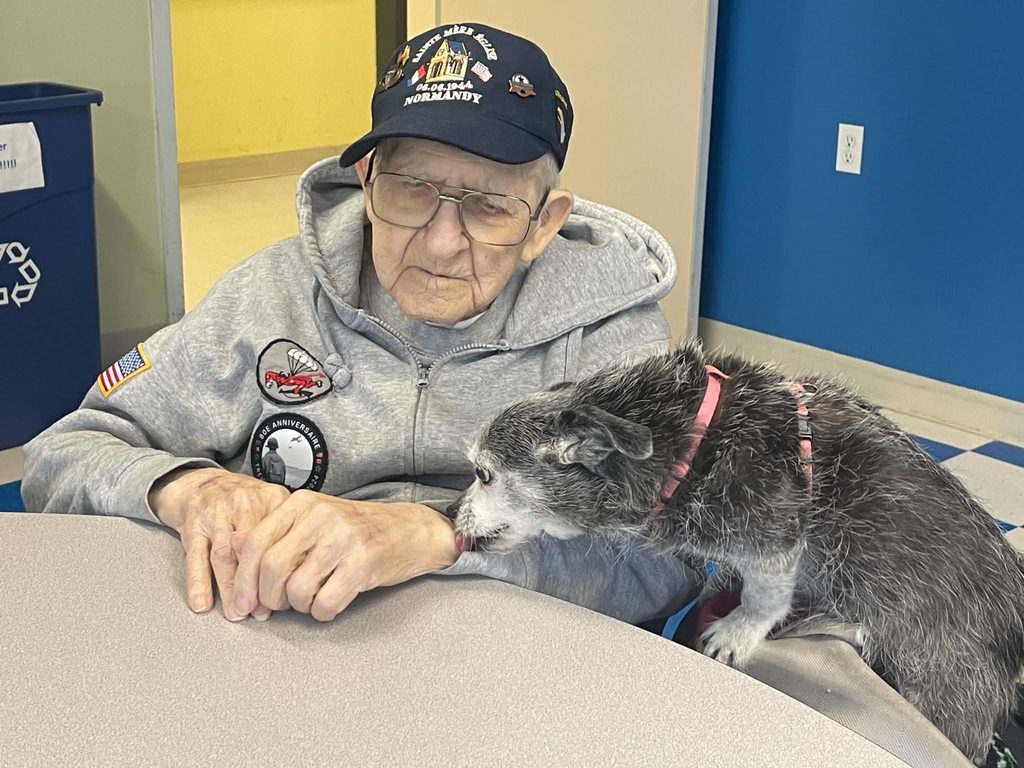
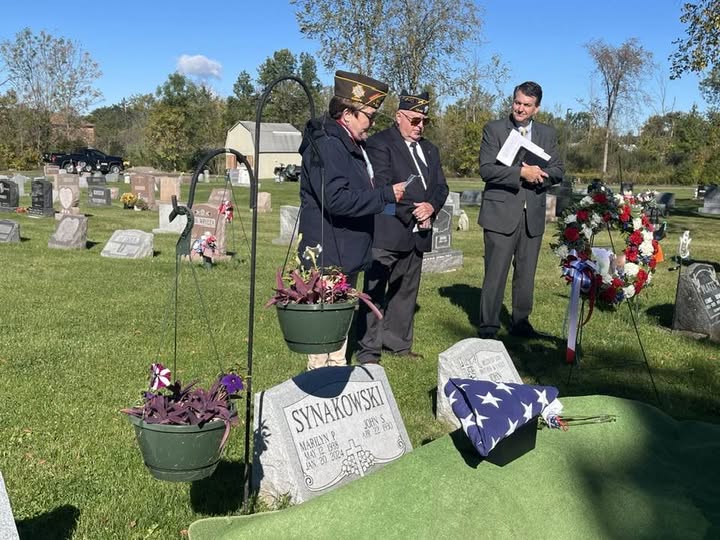
On September 10th, John “Joe” Synakowski passed away at the age of 96. My friend Mary Cooke, who was with him when he passed away, said that one of the last things he said was, “I had a good life.” Indeed he did, and Joe made an impression on a community that will never be forgotten. This is the first part of a story about Joe Synakowski and his amazing adventures. This morning, I attended his funeral, which was conducted outside at the cemetery at St. Stephen Roman Catholic Church in Grand Island, New York. Afterwards, a reception was held for him at a restaurant that is normally closed on Tuesdays. Many people there spoke about him. They laughed as they recounted his misadventures and his energy and they shed a tear or two as they remembered the love that they had for him. Indeed, Joe was very well loved.
The first time I met Joe Synakowski was at a Memorial Day ceremony here on Grand Island. After he spotted me, he strolled up to me and offered me a little flag to wave during the ceremony. He looked like he really enjoyed greeting people at the ceremony.
A few years ago, I found out that Joe Synakowski was among the youngest World War II veterans. I had the honor of interviewing him a few times and writing several articles about his experiences during and immediately after World War II, as well as in the Honor Flight, which he took just a few years ago.
Early in 1945, Joe Synakowski joined the U.S. Army.
“I entered the service before the end of the war. So, they designate you as a World War II veteran,” Synakowski said. “I lived the Army life for three years, and I did my duty, and I came home without a scratch.
“I was a young lad. My birthdate is April 22, 1930. So, that made me 15 years old at the time. I took it as something I could do for my country. I had the spirit. I had the get up and go. And I did.”
Joe said used his brother’s baptismal certificate to prove that he was 18 years old.
The name Joseph belonged to his brother. The person who used the baptismal certificate to join the military was actually John S. Synakowski. He was known as Joe for many years. It was only family who called him John.
By the time Joe finished his basic training, the war was ended. He received training in riot control and was then sent to Germany, where he received paratrooper training and became part of the 82nd Airborne Division. Then his unit was sent back to the United States. Since he had more than a year remaining on his enlistment, he was offered the opportunity to serve in the United States or to be deployed overseas. He chose overseas.
Joe/John told me that he was able to perform a valuable service in his second deployment. He had grown up in a part of the City of Buffalo where most people spoke Polish as their first language. His Polish language skills came in handy during his military service when he volunteered to serve at a prisoner of war camp as a Polish language interpreter.
I wrote in my article that Joe explained that the prisoners of war claimed they were not German: “They were Polish or they were Ukrainian or they were other nationalities. That was a ruse they used because a lot of them were SS men, and they didn’t want to get thrown into prison. The SS men were the elites in the German Army.
“We had to interpret different questions to see if they were actually Polish or German or what. That was my job. I only had about a six-month tour in that job. That was in the Dachau Concentration Camp (approximately 12 miles north of Munich, Germany). That’s where they put the German prisoners of war. By this time, the camp was pretty well cleaned up. There were no bodies around. They just used it for the German prisoners of war. We had to interrogate them to find out if they were actually German or whatever they were.”
After he left the concentration camp, he continued to serve as an interpreter.
“I went to a unit called the 301st Military Intelligence, and I worked with them for a while,” he said. “It was just normal work. If they told you to go to a displaced persons camp, you went and you did your questioning and trying to find out where these people belonged. There were a lot of displaced persons. They really had a job separating these people from the enemy. You had to do it because, otherwise, they could have maybe formed a group. They didn’t know what was on these people’s minds. So, they had to take precautions. Once you were in the Occupation Army, you had to be watchful. You had to do your duty and that was it.”
By 1948, the Cold War between the western nations (the Allies) and the Soviet Union and Eastern Europe (the Warsaw Pact) was warming up The Soviet Union blockaded Berlin, which caused people in that city to be unable to obtain the necessities of life. After all land and water routes to West Berlin were blocked, an effort was underway to provide necessities to the residents of West Berlin via an airlift. Joe participated in that airlift that provided more than 2.3 million tons of food, medicine, fuel, and coal to West Berlin. Titled “Operation Vittles,” this was the biggest airlift in the history of the world. It ended in 1949.
This is how Joe described the Berlin airlift: “The Russians closed the borders. Due to the fact that they couldn’t move the trains, they couldn’t move the cars, trucks or anything, we had to fly everything into Berlin. All the food and milk and whatever the people needed, we gave them. We made sure they had enough stuff to keep on living and subsistence. It was a very big operation, that Berlin airlift.”
After Operation Vittles ended, Joe returned to the United States, where he was discharged from the military.
Amazingly enough, after serving four years in the military, Joe was still a teenager.


